I Tracked 997 Chrome Extensions That Changed Their Titles
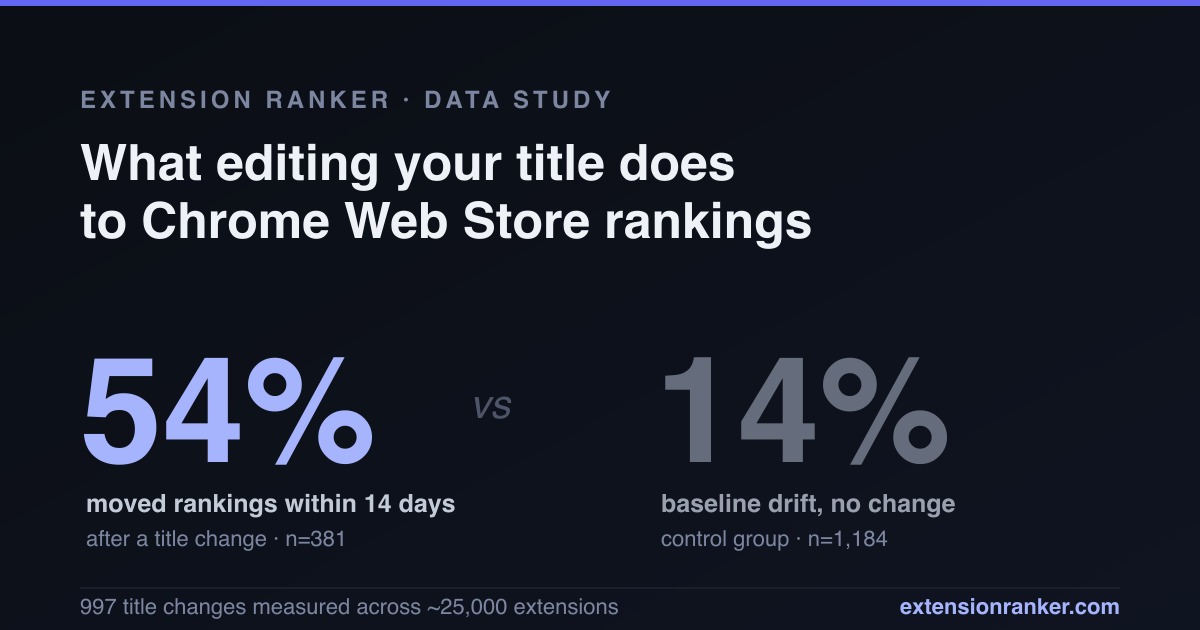
I tracked 997 Chrome extensions that changed their titles and measured what happened to their rankings — against a control group that didn't. Title changes move rankings within days, in both directions.
4 min read
The best way I've found to learn Chrome extension growth is watching what other developers actually do — and what happens to them after. Problem is, you normally only get to see your own experiments. I wanted to see everyone's.
So early on while building my rankings tracker, I started logging daily Chrome Web Store search rankings for a couple thousand keywords, plus every listing change from the extensions showing up in them. Since early March, 997 out of the ~25,000 extensions in that dataset changed their title at some point. That's about 50 title experiments a week, running in public — and almost nobody reads the results, including the developers who ran them.
So I read them.
What the data says
For 381 of those extensions, I had enough ranking data on both sides of the change to measure it properly. And because "rankings just move sometimes," I ran the exact same measurement on ~1,200 extensions that never touched their titles, as a baseline.
The comparison:
| Title changers (n=381) | No change (n=1,184) | |
|---|---|---|
| At least one keyword moved 3+ positions within 14 days | 54% | 14% |
| Moved in both directions at once (some keywords up, others down) | 6% | 0.2% |
Within the changers, 30% gained 3+ positions on at least one keyword and 30% lost 3+ on at least one. Almost a perfect coin flip.
So no — this isn't normal drift. Editing your title makes your rankings about 4x more likely to move within two weeks, in either direction, with roughly equal odds each way. A gap that size between 381 changers and 1,184 non-changers isn't a sampling fluke; what I haven't fully ruled out is confounds — more on that below.
The cleanest specimen
On June 18, Mailmeteor (~60K users) changed its extension title from "Gmail AI Email Assistant" to "Mail Merge for Gmail". No version update around that date, rating steady — as far as I can tell, only the words changed. I had 22 of their keywords in the daily crawl.
Average rank, three weeks before vs. three weeks after:
| Keyword | Before | After |
|---|---|---|
| mail merge for gmail | #7.7 | #1.8 |
| mail merge gmail | #7.9 | #2.0 |
| gmail mail merge | #8.0 | #2.2 |
| email assistant | #1.0 | #11.0 |
| ai email assistant for gmail | #1.3 | #6.4 |
| gmail ai assistant | #1.5 | #7.8 |
"Email assistant" undersells it at #11 — after the change, they stopped appearing in the visible results for that keyword in most of my scrapes entirely. They held #1. Gone within days.
They sold a #1 to buy three top-3s — and from the outside it looks deliberate. Two weeks later, their displayed user count slipped from the 60K bucket to 50K. Whether the trade was worth it is genuinely hard to say from the outside: rankings aren't installs, and I can't see their conversion numbers. My lean is that it was smart — intent-matched traffic should beat broad traffic — but that user dip gives me pause.
Methodology, honestly
The 3-position threshold and 14-day windows are choices I made. The no-change baseline uses identical thresholds, over fixed mid-window dates, on a ~10% random sample. At the aggregate level I haven't ruled out confounds (version updates, rating shifts) for all 381 extensions — only for the Mailmeteor case above, which I checked by hand. So read the percentages as "rankings moved at these rates after title changes," not as proven causation in every case.
Picking the right keyword matters even more
Ranking for a phrase that says exactly what you do beats ranking for a broad one. And an uncrowded phrase beats a crowded one.
Some store-wide context: of all the #1 spots I track, only 44% have every word of the query in their title. The other 56% are held up by something else — user mass, ratings, partial matches. That 56% is where the following pattern keeps showing up.
Take "YouTube video to text." In my keyword set it shows up as four different phrasings: "YouTube Video Transcript" (~88K Google searches/mo), "YouTube Transcript Generator" (~83K), "YouTube To Text" (~38K), "YouTube to Transcript" (~31K). This niche has giants. The big AI-summary extensions sit between 400K and 1M users, and none of them cracks the top 10 for any of these four phrases. All four #1 spots belong to four different extensions, each with a title that matches its phrase word for word. Most of them are only around 20K users. I've had two in the tracker for nine months and both doubled: one went from 10K to 20K users while its reviews grew from 61 to 201. They just sit on their #1 every day, and the giants never come in.
One catch though: the phrase needs real volume. I've got the counter-example in the same dataset — an extension that ranked top 3 for a bunch of ultra-narrow phrases, and its user count barely moved off zero. Quick sanity check before you chase a phrase: look at whether the extensions currently on top of it are growing. If they are, the traffic is real. If they're all flat, that search-volume number is probably a mirage — nobody actually types it into the store. (Volume numbers everywhere, including mine, are Google-side estimates; Google doesn't expose store-internal search volume to anyone.)
If your extension is small
I'd read most of this as good news. Your title is the one ranking input you fully control from day one, and it works fast. The store re-reads what your words say almost immediately — in both directions. So treat title edits as trades, not rewording: every word currently in your title is holding up specific rankings, and removing it means handing those positions back. Figure out what you're selling before you decide what to buy.
For the deeper mechanics of how CWS ranking dimensions stack (relevance, user signals, ratings, badges), see my earlier analysis of 120,000 ranking records and the full CWS SEO Guide.
If you've renamed an extension and watched something weird happen after — or nothing at all — I'd genuinely like to hear about it: on X or the comments wherever you found this.
I build Extension Ranker, the rankings tracker behind this data. All numbers come from public Chrome Web Store search results.

Keep reading


TRY IT ON YOUR EXTENSION
See how your extension ranks
Track the Chrome Web Store keywords you care about and see what moves your rankings.