CURRENT STATE
What does this extension look like now?
Review users, rating, reviews, version, badges, locales, and store metadata from the latest indexed snapshot.
01 / RESEARCH
Search any indexed Chrome extension by name, store URL, or ID. Analyze a competitor's current profile, listing history, version changes, and public growth signals before deciding where to compete.
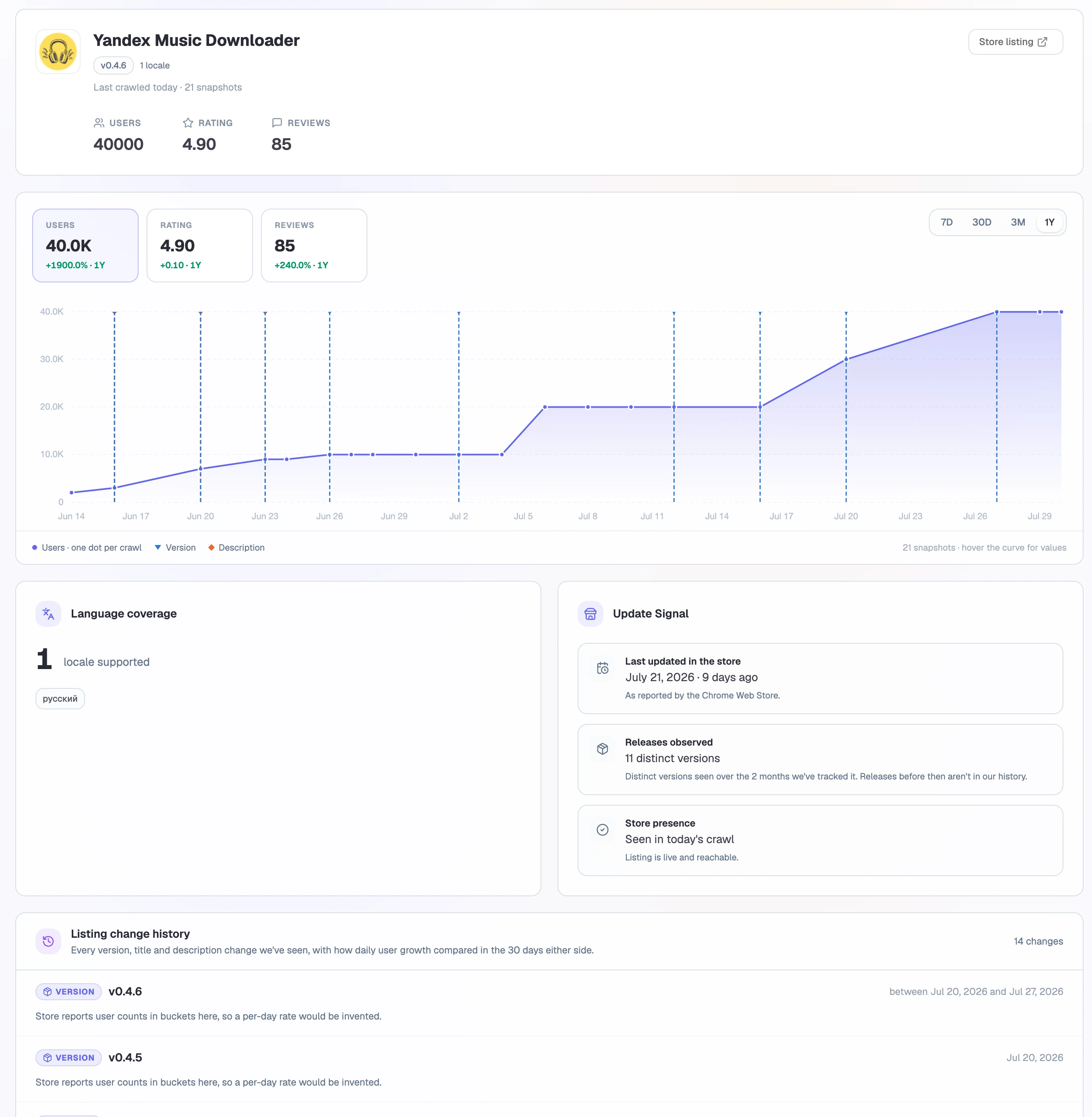
Live Extension Lookup interface captured from an active Extension Ranker workspace. Metrics reflect the selected extension at capture time.
THE DECISION
Extension Lookup connects the current extension profile with the observations that came before it, so one interesting change can become the start of a useful investigation.
CURRENT STATE
Review users, rating, reviews, version, badges, locales, and store metadata from the latest indexed snapshot.
OBSERVED CHANGE
Follow version, title, description, and Featured-status differences detected between crawler observations.
GROWTH CONTEXT
Compare available growth before and after an event without turning correlation into a causal claim.
PRODUCT FLOW
The workflow keeps the latest profile, historical metrics, and detected changes in one investigation path.
Search by name, paste a Chrome Web Store URL, or enter the 32-character extension ID.
Open the latest profile and see which historical series are available for this extension.
Move from a point on the timeline to the version or listing difference recorded around it.
Use available before-and-after growth context to decide whether the event deserves deeper research.
THE EVIDENCE
The useful unit is not a single scrape. It is the connection between current metadata, historical series, and the intervals in which a change was first observed.
LATEST SNAPSHOT
Users, rating, reviews, version, badges, locales, last store update, and other indexed store fields.
TIME SERIES
Collected user, rating, and review snapshots reveal direction while respecting the precision exposed by the source.
FIELD DIFFERENCES
Adjacent observations reveal supported changes to version, title, description, and Featured status.
CONTEXT WINDOW
Where coverage allows, compare the 30 days before and after an observation instead of judging one point alone.
HOW TO READ THIS
History reflects periodic crawler snapshots. It can show that a supported field changed between two observations, not the exact edit time or the cause of later growth.
PRODUCT QUESTIONS
No. It only means Extension Ranker does not currently have the extension in its crawler index.
Where snapshots support them, the profile can surface version, title, description, and Featured-status changes alongside users, ratings, and reviews.
Not always. A change is detected between crawler observations, so the product presents the observation interval instead of inventing an exact edit time.
Yes. You can inspect any extension currently available in the crawler index without proving ownership.
NEXT DECISION
Once you understand the extensions in a category, evaluate which keyword is worth targeting.