EDIT THE LISTING
The search results say your authority is competitive.
When title or content is the weaker side, the report points to the editable gap and opens the same audit context in Listing Lab.
See what's likely holding your ranking back, and know what to do next.
Not ready to sign up? Grade your listing free →
The result set does not justify another authority-first strategy. Improve target coverage in the listing before investing elsewhere.
Title + content factors you can edit in the listing.
Users, popularity, and visible trust signals.
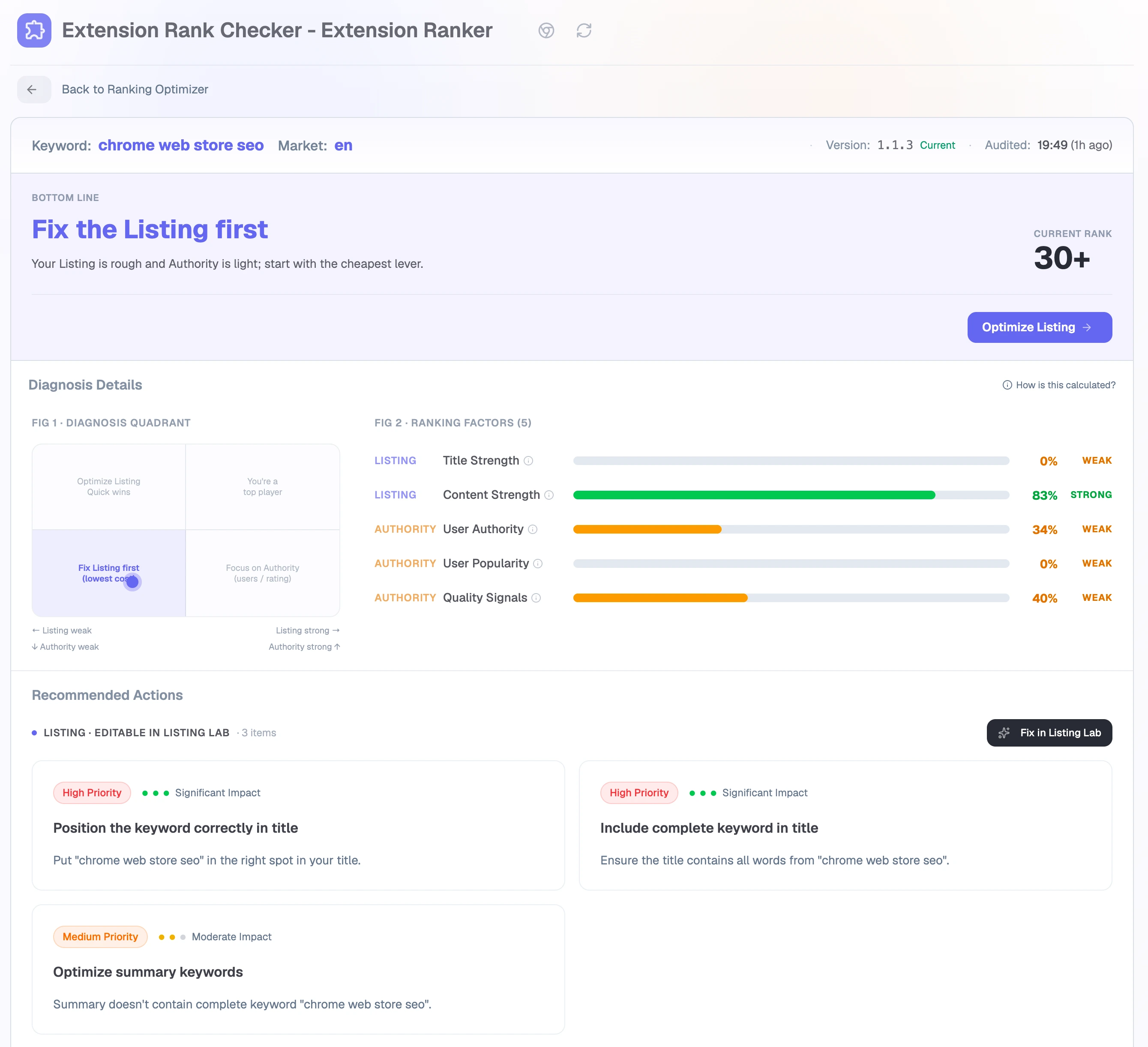
Live Ranking Audit interface captured from an active Extension Ranker workspace. The report reflects the selected keyword and market at capture time.
THE FIRST DECISION
A score leaves you with interpretation work. Ranking Audit first decides whether the evidence supports editing, building authority, or reconsidering the target.
EDIT THE LISTING
When title or content is the weaker side, the report points to the editable gap and opens the same audit context in Listing Lab.
BUILD AUTHORITY
When the listing is already strong but users, ratings, or reviews trail the winners, the report stops prescribing another rewrite.
CHANGE THE TARGET
When the competitive ceiling remains out of reach, the next action can be a different keyword instead of more work on the wrong one.
THE AUDIT SNAPSHOT
Every report is a time-bound comparison, not a generic grade that floats free of the market that produced it.
Illustrative rows show the comparison structure. A real audit preserves the actual search results and competitor features captured at that time.
DIAGNOSIS DETAILS
Listing is editable now. Authority is slower to change. The report uses that distinction to stop a weak authority position from being misdiagnosed as a copywriting problem.
Target placement and title relevance compared with the audited search results.
Summary and description coverage, frequency, position, and completeness.
The extension’s user base relative to the extensions in this search.
Rating, review volume, and the interaction between those visible signals.
Visible Chrome Web Store trust markers such as Featured and Established Publisher.
WHY THIS RECOMMENDATION
The report does not produce a list of SEO tips. It moves from a measured gap to the action most likely to change that gap.
FACTOR GAP
The report does not treat every low score equally. It first separates listing factors you can edit from authority factors that need another strategy.
COMPETITOR EVIDENCE
A recommendation stays connected to the extensions, keyword, and market that made the gap relevant.
ACTION TYPE
Editable gaps lead toward Listing Lab. Authority gaps lead toward users, reviews, ratings, or a different target.
PRIORITY
Recommendations carry priority, expected impact, current value, target value, difficulty, and a practical next step.
Your Content Strength is the clearest editable gap. Bring target coverage closer to the pattern visible among the top results before changing the higher-performing title.
High, medium, or low
Significant, moderate, or slight
The measured gap the action addresses
How demanding the action is expected to be
Practical steps where the recommendation supports them
Listing Lab for editable listing actions
PREDICTED CEILING
The ceiling asks what the listing could support if editable listing factors were maximized while everything else in the audit stayed the same.
AUDIT QUESTIONS
The report keeps the target keyword, search market, extension version, factor scores, recommendations, and competitor features that produced the diagnosis.
Listing combines the title and content factors you can edit in the store listing. Authority combines visible user, popularity, and quality signals that usually take longer to change.
It estimates the listing-maximized scenario against the audit context, helping you judge whether editing is worth the effort. It is not a promised future rank.
Rerun it after a meaningful listing or version change, when targeting another market, or when you need the recommendation to reflect a fresh competitor set.
Use the current search results to decide whether to edit the listing, build authority, or spend the effort on a better keyword.
Start an audit