How Are Chrome Web Store Ratings Calculated Now? What the Data Suggests
Thousands of Chrome extension ratings shifted in October 2026. Our daily data suggests the store may now average only the most recent ~75 ratings.
Updated 8 min read

On October 14, 2026, the Chrome Web Store ratings of thousands of extensions shifted all at once.
Overnight, Return YouTube Dislike, with 5 million users, dropped from 4.5 to 2.5, while the Claude extension, with 18 million users, rose from 2.9 to 3.7.
In its August 20, 2026 announcement, Google had already said extension ratings would put more weight on recent reviews, to better reflect how users feel today. But it never said what "recent" means, or how Chrome Web Store ratings are now calculated.
Extension Ranker records ratings, rating counts and public reviews in the Chrome Web Store every day. Comparing that data before and after the update, my read is that this wave of rating changes is most likely a new rating calculation rule taking effect.
Thousands of Chrome extension ratings changed
Around October 14, Extension Ranker recorded displayed rating changes on more than 4,200 extensions. Comparing scores before and after, about 3,000 went down and 1,200 went up.
Well-known extensions with millions, even tens of millions, of users were among them. AdBlock, Honey and LastPass dropped noticeably, while Chrome Remote Desktop, Claude and 1Password went up.
| Extension | Users (shown in store) | Ratings | Rating on Oct 13 | Rating on Oct 15 |
| AdBlock | 65M | 290,300 | 4.5 | 3.9 |
| Honey | 13M | 179,600 | 4.6 | 2.2 |
| LastPass | 8M | 28,500 | 4.2 | 1.8 |
| iCloud Bookmarks | 7M | 4,200 | 3.4 | 1.7 |
| EndNote Click | 7M | 379 | 4.0 | 2.1 |
| Dark Reader | 7M | 13,200 | 4.7 | 4.3 |
| Return YouTube Dislike | 5M | 19,900 | 4.5 | 2.5 |
| Xunlei Download Support | 84M | 1,400 | 2.9 | 4.0 |
| Chrome Remote Desktop | 41M | 3,000 | 3.1 | 3.8 |
| Claude | 18M | 1,800 | 2.9 | 3.7 |
| 1Password | 7M | 3,600 | 3.1 | 4.1 |
In Extension Ranker's tracking, large extensions with big user bases were the most visibly affected. Among extensions with a million or more users, about three-quarters saw their score change, with both sharp drops and clear gains.
Part of the reason may be that extensions with more users usually have more ratings too. Xunlei Download Support has 84 million users but only 1,400 ratings; EndNote Click has 7 million users and just 379 ratings. Both still moved by more than a point, which hints that rating count may matter more than user count.
To make sense of these changes, we need to go back to what Google meant by "recent."
What the data suggests
I started with time: how long a period does Google's "recent" actually cover?
I took recent reviews over different time ranges, averaged them, and compared the results with the displayed ratings. None of these time-based models consistently explained the new ratings across extensions.
When I switched to count, a pattern appeared: across several rounds of comparison, the average of the latest 75 public ratings came closest to the adjusted displayed rating.
If the store really does average a fixed window of 75 ratings, extensions with fewer than 75 ratings would have every rating inside the window, and their scores shouldn't change much. The chart below checks that.
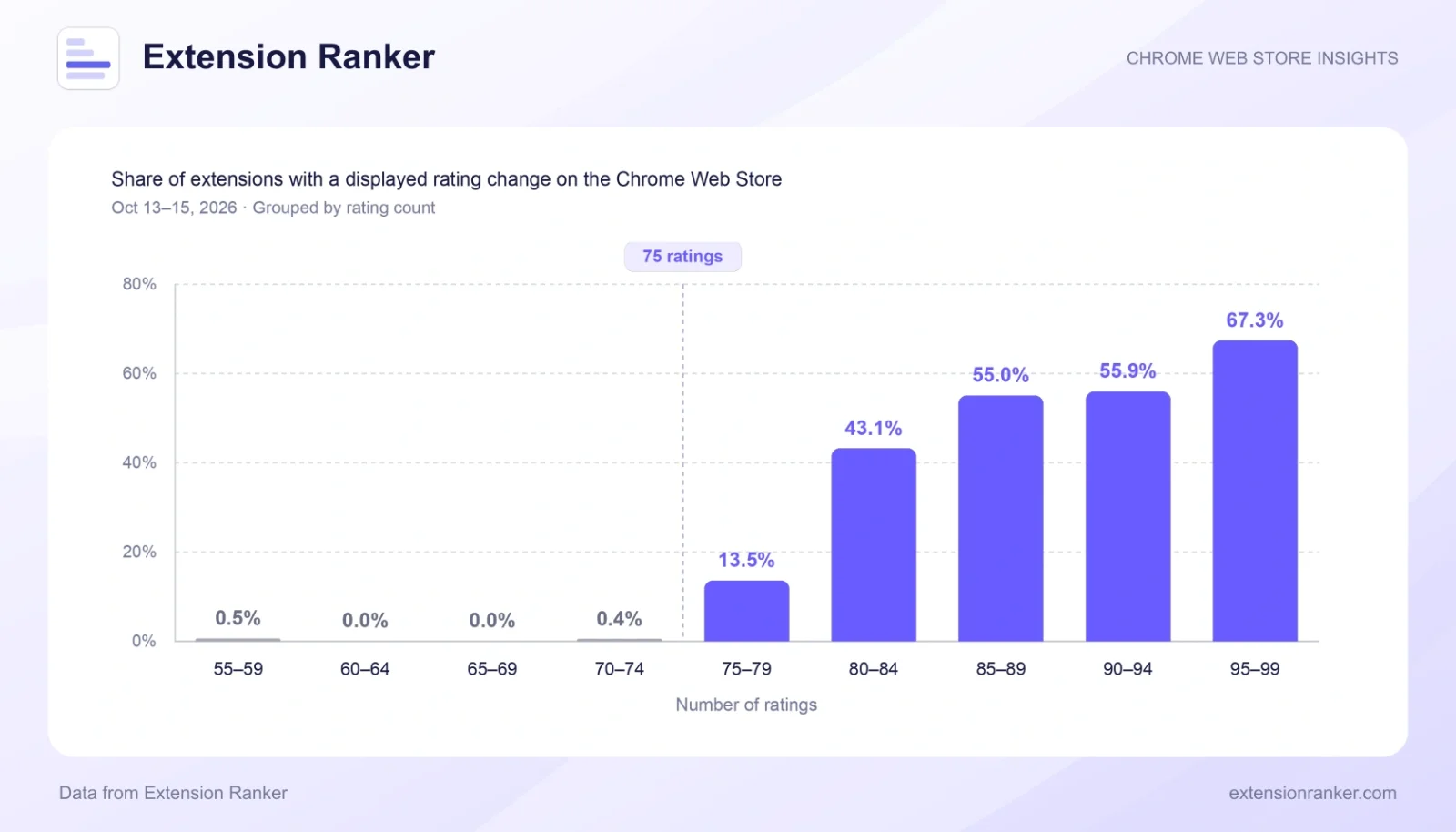
The chart compares the share of extensions whose rating changed between October 13 and 15, grouped by rating count. The groups under 75 ratings barely changed. From the 75–79 group on, the share rises sharply and keeps climbing. That fits a 75-rating window: extensions just past 75 only lose their oldest few ratings, often not enough to move a one-decimal average, while those with more ratings lose more.
Still, when I calculate from public reviews one by one, the result often doesn't match the store rating. I think a reasonable explanation is that the store uses more ratings than the reviews you can see on the page.
Some users rate an extension without writing a review. Those ratings may not appear in the public review list we can collect, but they may still count toward the store score.
For example, suppose 5 of the most recent 75 ratings that actually count were never publicly recorded. Taking the latest 75 public reviews would then pull in older ratings and miss ones that should count, producing a different average.
This could explain part of the gap, and the actual rule may also include time weighting or filters. 75 remains a research hypothesis based on public data. It doesn't yet show that every extension switches to a new calculation at its 76th rating.
What the new rating calculation means for developers
Google has made its direction clear: ratings will lean more on recent reviews. For developers, the question worth revisiting is how far years of accumulated good reviews still reflect what users experience today.
Recent ratings may carry more weight
If the store averages the last 75 ratings with equal weight, each new rating replaces an older one in the window. A 1-star replacing a 5-star lowers the average by about 0.05; twice in a row, and the displayed rating may drop by 0.1.
This example shows how sensitive a fixed window is. Even with a large rating history, one buggy update can hit your displayed score harder, and fixing old problems and winning users back can show up in your score sooner.
If you don't have many ratings yet, keep an eye on changes as you approach 75, but don't treat it as a switch every extension is certain to hit.
How recent "recent" is depends on how fast you get ratings
If the window is set by a number of ratings, the time it covers depends on how fast ratings come in. 75 is a fixed count, not a fixed period. Based on the public reviews ER has recorded, here is the median time span covered by the latest 75 public reviews:
| Ratings | Time span of the latest 75 public reviews (median) |
| 10,000+ | ~3 months |
| 1,000–9,999 | ~15 months |
| 200–999 | ~2 years |
| 75–199 | ~3 years |
Star-only ratings aren't in the public list, so the real window is shorter. Treat these numbers as upper bounds.
For large extensions that get ratings quickly, the store rating basically reflects the last quarter's reputation. For most small and mid-sized extensions, "recent" isn't recent at all: the bad reviews from one broken release can sit in the window for a year or two, and only new ratings can push them out, one at a time.
Ratings will become a more important quality signal
In the same announcement, Google said it plans to retire the Featured badge later this year, and encouraged developers to treat the new rating system as an important signal of extension quality. That gives developers a clear direction: keep improving the product so that what users experience today lives up to the score in the store.
How to protect your Chrome extension rating now
Use recent low-rated reviews to find problems
Public reviews can't fully reconstruct the rating formula, but they can tell you why users are unhappy.
Sort recent low-rated reviews by issue: login failures, payments and subscriptions, export, sync, permissions, or unclear instructions. Prioritize problems that keep coming up and block core tasks, and check whether they cluster around a particular version or environment.
After every release, keep following up on feedback
After shipping a new version, check new reviews daily for a week. If your extension gets ratings slowly, extend that window.
When the same failure shows up repeatedly, reproduce it quickly and decide whether to fix or roll back. Once it's resolved, say which version fixed it and how, in reply to the original review or through your support channel, and invite affected users to try again.
Looking at your displayed rating, total ratings, public reviews and release dates together helps you tell whether a change introduced new problems, and whether past fixes actually worked.
Make your support channel easy to find
Put a clear way to give feedback, like a support email or an issue form, in your extension's settings page, help menu and store listing, so users know where to go when something breaks.
If users can't find a way to contact you, the store review becomes their feedback channel. A support channel that's easy to find and actually answered may lead some users to ask for help first instead of leaving a bad review. When feedback comes in, keep users posted on progress and let them know once it's fixed.
Ask for a review when users actually get value
For example, after they complete a core action or after several days of use, offer a natural way to leave a review and share how it's going.
Make that prompt available to all users. And don't trade rewards for ratings: the Chrome Web Store's Spam and Abuse policy prohibits manipulating rankings through fake or incentivized ratings and reviews.
Ratings are no longer an asset you build once and keep
It used to be that once an extension collected a few thousand good reviews, its score was basically locked in. Now, once you pass 75 ratings, the store only shows how the most recent batch of users feels, and every new rating replaces an old one.
For developers, ratings have gone from a one-time accumulation to a metric that needs ongoing upkeep. How well you've done lately on release quality, onboarding and pricing will show up in your score more directly, and the faster you get ratings, the faster it shows.
Two questions are still open:
- Google hasn't confirmed this rule, and details like star-only ratings and time weighting need more data to verify.
- Will these rating changes affect store search rankings, and in turn installs?
I'll use Extension Ranker's ranking data to look at the second question in a separate post, and I'll keep tracking rating changes after this update.
FAQ
How are Chrome Web Store ratings calculated now?
Google hasn't published the formula. Its August 2026 announcement only says ratings now put more weight on recent reviews. Extension Ranker's data suggests the displayed rating is roughly the average of the most recent ~75 ratings, but Google hasn't confirmed this.
Why did my Chrome extension's rating drop in October 2026?
If your extension has more than about 75 ratings, its displayed rating was likely recalculated around October 14–15 using only recent ratings. If your recent ratings are lower than your older ones, your score went down.
Does the change affect extensions with fewer than 75 ratings?
Not yet. In our data, almost none of them changed. Once an extension passes about 75 ratings, its oldest ratings start dropping out of the calculation.
Do star-only ratings without a written review count?
Yes. Users can rate an extension without writing a review, and those ratings count toward the store score but don't appear in the public review list. That's one reason a score calculated from public reviews alone often doesn't match the store.
Does the rating affect Chrome Web Store search ranking?
Google's Chrome Web Store curation and reviews page says the number of ratings and the average rating are taken into account when prioritizing items. Whether this update moved rankings is the question I'll look at in the next post.
Data in this article comes from Extension Ranker's daily records of the Chrome Web Store, through October 21, 2026. A "rating change" means the one-decimal rating displayed in the store changed; user counts and rating counts are the values the store displays. "The most recent ~75 ratings" is a rule reverse-engineered from public data and has not been confirmed by Google.

Keep reading



TRY IT ON YOUR EXTENSION
Grow your extension from search
Track rankings, find keywords and optimize your Chrome Web Store listing.